
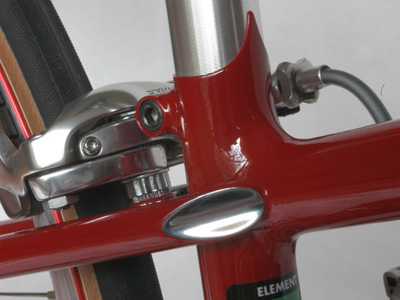

“You have gained a new source of enjoyment, and it is well to have as many holds upon happiness as possible.” ― Jane Austen, Northanger Abbey
Wherein a new source of enjoyment is presented as a gift to encourage a healthy, happy life.
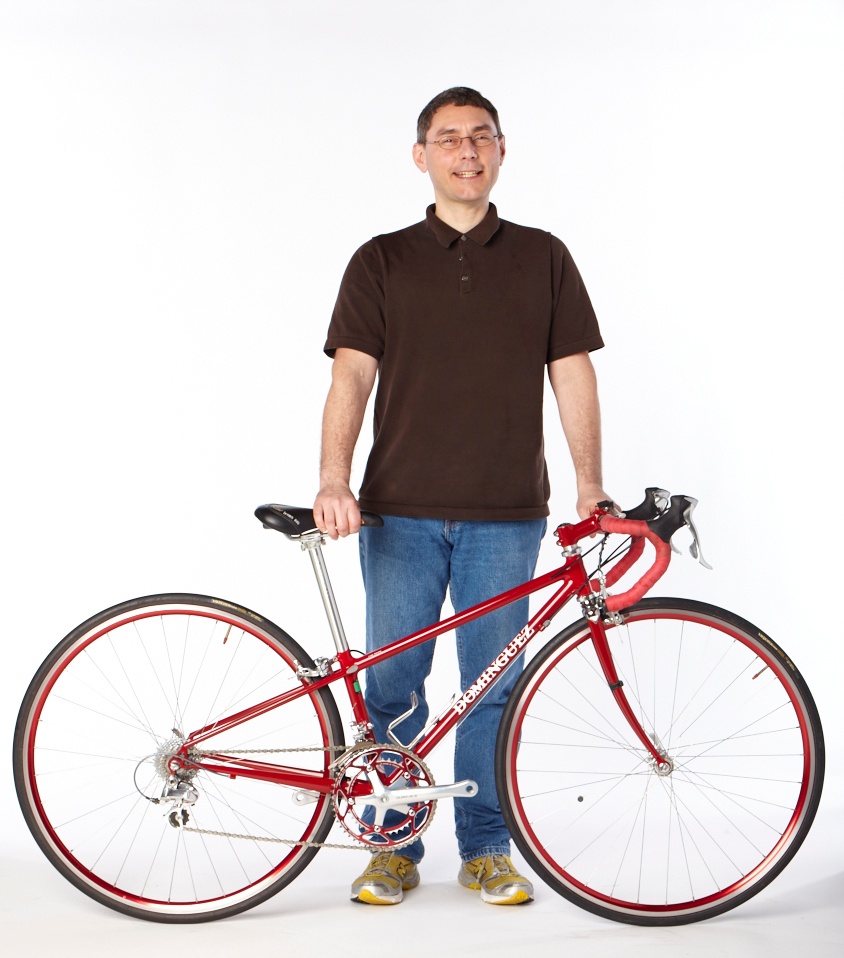
This is the first bicycle frame I built – the frame that started me on the long road of frame-building. It was built under the tutelage and watchful eye of Paul Wyganowski during the winter of 2001 through the summer of 2002. It was finished in June of 2002, but didn’t come back from paint until May of 2003.
I Have a Dream
During 1980, on a mild March afternoon, my brother went to pick up his new bicycle frame, with me in tow. The frame was custom-made by Terry Osell, a Minnesota frame builder. Terry learned his craft from Cecil Behringer in the early 1970s. It was a memorable outing. My brother left Terry’s garage with his new frame, and I left with my brother and a new dream: to build my own bicycle frames.
Twenty-one years later…I visited Terry in his northeast Minneapolis bicycle shop to ask him whether he was willing and able to teach me how to build frames. He was no longer teaching, and very affably declined. But, he directed me to his shop helper, Paul Wyganowski, who was willing to teach me. Paul had been a student of Tim Paterek, who is the author of The Paterek Manual for Bicycle Framebuilders. Tim had been a student of Terry Osell.
My entirely self-serving dream had nothing to do with carrying on the traditional legacy of these fine Minnesota bicycle framebuilders. I simply wanted to combine the joy of creating things with my own hands and the joy of riding bicycles. Nevertheless, I am grateful to have been welcomed into the local frame-building community.
Background
The owner of this bicycle was often found in the wilds of urbia riding her Georgena Terry-styled Panasonic bicycle for commuting and fitness. This was during the 1980s and 1990s, before high-quality tires could be readily had in smaller diameters and greater widths for enthusiasts. Good quality tires for a 24″ front wheel were usually only as wide as 23mm or 25mm (or otherwise of very low quality), which made the ride less than ideal in such a small diameter. And, it made carrying two inner tubes (700C and 24″) a requirement on long rides.
At 155cm (5′ 1″) tall, the owner was short-legged with a relatively long torso, but certainly suitably proportioned to fit a bicycle with 700C wheels, front and back. A 700C x 25mm tire would make the ride slightly more comfortable and the frame could be designed to fit wider tires in the future.
This one-of-a-kind, Dura-Ace-equipped, handmade-with-love, custom bicycle was built for fair-weather day rides around the neighborhood and beyond. It was my first, very ambitious attempt at bicycle frame-building. It was ambitious only in hindsight: I had no idea what I was doing or how much labor and expense were involved to realize my vision for this bicycle.
The Plan
Other than my plan to use a complete Shimano 7700-series Dura-Ace group, the design for the frame itself was undertaken during my first day of instruction from Paul Wyganowski in his basement workshop.
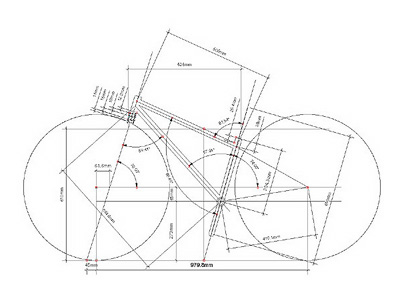
The geometry was worked out with a pencil, a ruler, and a protractor, adapted from well-established road geometry for nimble, yet stable handling:
| Part | Description |
|---|---|
| Top tube length (c-c) | 52.0cm equivalent |
| Seat tube length (c-t) | 33.5cm (46cm equivalent) |
| Bottom bracket drop | 7.0cm |
| Chain stay length | 43.5cm |
| Front center | 55.7cm |
| Wheel size | 700C (622mm) |
| Fork offset | 5.2cm |
| Trail (25mm tires) | 4.5cm |
| Head angle | 73.0° |
| Seat angle | 73.0° |
| Wheelbase | 98.2cm |
To combine durability with a lively road feel, the tubing was selected according to Paul’s recommendations, taking into consideration the weight and strength of the rider:
| Part | Description |
|---|---|
| Head tube | CrMo - 31.8mm ø (1.1mm) |
| Top tube | Tange Prestige - 25.4mm ø (.8/.5/.8) |
| Down tube | Columbus SL - 28.6mm ø (.9/.6/.9) |
| Seat tube | Columbus SL - 28.6mm ø (.9/.6) |
| Bottom bracket shell | CrMo - 68mm width, 1.37" x 24TPI |
| Chain stays | Columbus Zona - 30/16mm round-oval (.8/.6) |
| Chain stay bridge | CrMo - 9.5mm ø (.9) |
| Seat stays | Tange Prestige - 16/12.5mm ø (.8) |
| Seat stay bridge | Cinelli 806 |
| Dropouts | G.P. Wilson - semi-vertical, 17-4PH stainless, super-light |
| Steerer | Columbus Thron - threadless 1” |
| Fork Crown | Long Shen LC-01 - stainless steel (38.5mm) |
| Fork Blades | Tange Prestige - 30/16mm ø (1.3/.9) |
| Fork Ends | G.P. Wilson - 17-4PH stainless, super-light |
Components were selected based on long-term durability, quality, and serviceability, also taking into consideration the weight and strength of the rider. [What I consider to be] Sixth-generation Dura-Ace (7700-series, ca. 1996) was selected as an upgrade from the owner’s previous second-generation Shimano 105-equipped (1050-series, ca. 1986) Panasonic:
| Part | Description* |
|---|---|
| Headset | Cane Creek - Al alloy, silver - EC30, ISO 26.4mm ø CRS, threadless, sealed cartridge bearing |
| Stem | Ritchey Pro - Al alloy, color-matched - 80mm x 26.0mm ø |
| Handlebars | Ritchey Pro - Al alloy, black - 26.0mm ø x 42cm (c-c) |
| Handlebar tape | Cinelli Cork Ribbon - cork/PU, black |
| Handlebar ends | Velox - rubber, black |
| Shift/brake levers | Shimano Dura-Ace (ST-7700) - Al alloy, silver, black rubber hoods - dual-control, 9-speed indexed |
| Seatpost | Thomson Elite - Al alloy, silver - 27.2mm ø, no set-back |
| Saddle | Selle Italia LDY - leather, black, MnMo rails - slotted top |
| Brakes | Shimano Dura-Ace (BR-7700) - Al alloy, silver - dual-pivot SLR, short-reach |
| Pedals | Shimano XT (PD-M959) - Al/Fe alloy, silver - clipless SPD |
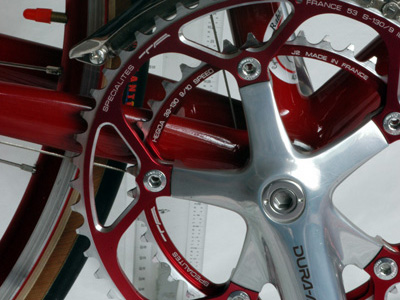
| Crankset | Shimano Dura-Ace (FC-7700) - Al alloy, silver - 130mm BCD, 172.5mm, OctaLink interface, HollowTech |
| Chainrings | Specialités T.A. - Al alloy, red - 38/52T, 130mm BCD, pinned/ramped |
| Bottom bracket | Shimano Dura-Ace (BB-7700) - Al/Fe alloy, silver - 1.37" x 24TPI threaded, sealed caged roller/ball bearing |
| Chain | Shimano Dura-Ace (CN-7700) - Fe alloy, silver - 9-speed HyperGlide |
| Cassette | Shimano Dura-Ace (CS-7700) - Fe/Ti/Al alloy, silver - 12-25T, 9-speed HyperGlide |
| Dérailleur - front | Shimano Dura-Ace (FD-7700) - Fe/Al alloy, silver - braze-on |
| Dérailleur - rear | Shimano Dura-Ace (RD-7700) - Al alloy, silver - short-cage, 28T maximum |
| Hubs | Shimano Dura-Ace (FH-/HB-7700) - Al/Fe alloy, silver - 36-hole, 130/100mm OLD, sealed loose bearing |
| Spokes | DT Swiss Champion - stainless steel, silver - 15-gauge, nickel-plated brass nipples |
| Rims | Mavic CXP-33 - Al alloy, red - aero-section 700c x 18mm, 36-hole, internal eyelets, machined brake track, welded seam |
| Inner tubes | Vredestein - butyl, black - 700C x 18-25mm, brass Presta valve |
| Tires | Vredestein Fortezza - rubber, black - 700C x 25mm (25-622) |
| Water bottle cages | King - stainless steel, silver - 2x |
| Computer | Shimano Flite Deck (SC-6501) - plastic, silver - dual-control-integrated buttons |
| * Last known configuration | |
Mistakes Were Made
The best way to learn is to make mistakes. “Mistake” is just a synonym for learning opportunity.
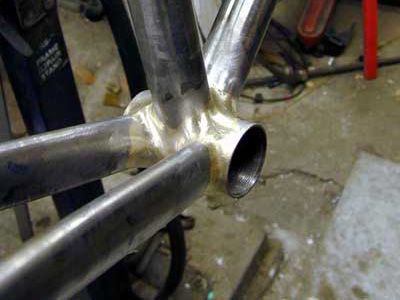
After much care was taken to fillet-braze the seat tube to the bottom bracket shell, it was then time to cut the seat tube to length, all according to plan. The old adage, “measure twice, cut once” was followed to the letter, but I would later amend it to be, “pay attention, measure twice, cut once”.
I had taken the 25′ tape measure in hand and measured from the stand-over height to the floor, carefully writing down the number where the mark on the tape entered the tape measure body. The mistake is obvious to you here, and for me in hindsight: I did not take into account the length of the tape measure body (8cm) itself, so the number I wrote down was incorrect from the beginning. I did measure it twice. It was short by 8cm both times and I did not see my mistake until after I had cut the seat tube too short.
What to do?
Two Options
The first option was to cut the seat tube away from the bottom bracket shell and then replace it, building up the fillets again. This would be a very labor-intensive option, but would stay true to the original design.
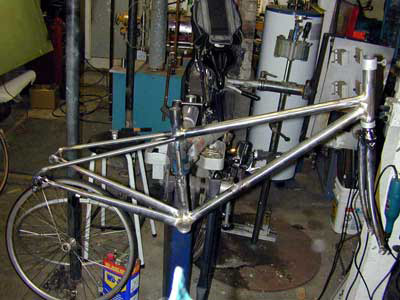
The second option was to adapt the design to work with the new seat tube length. Was it even possible to find a seatpost long enough to make this work? Making changes to the drawing using the pencil, ruler, and protractor, it was determined that, yes, the design could still work. I could use a 41cm seatpost without issue for this very light-weight rider. The resulting frame style was more that of a BMX frame: the design turned out to be quite well-suited to this little bicycle.
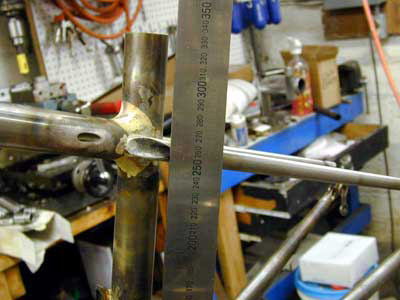
I decided in favor of the second option.
Nine Months Later…
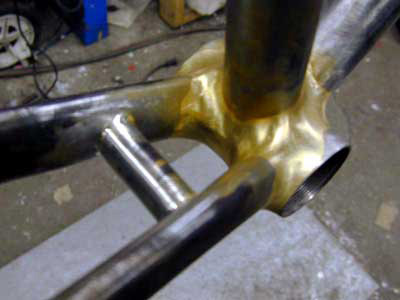
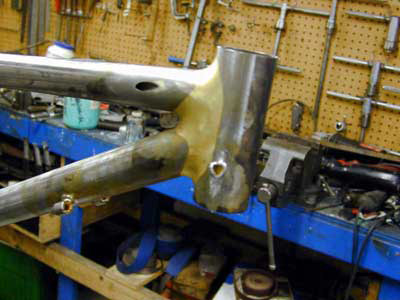
Over the course of nine months, I constructed this little frame (46cm equivalent) from Columbus SL and Tange Prestige tubing. Except the top tube at the head tube and initial tacking of the seat tube to the bottom bracket shell, the brazing was done by me. The exceptions were done by Paul to demonstrate construction processes and heat control for fillet-brazing with bronze. All of the finishing work, including the polished stainless steel, was done by me. This frame is still the baseline by which I measure my own work today.
The main tubes and chain stays were fillet-brazed using bronze filler. The seat stays, fork, and all braze-ons were assembled using 56% silver filler.
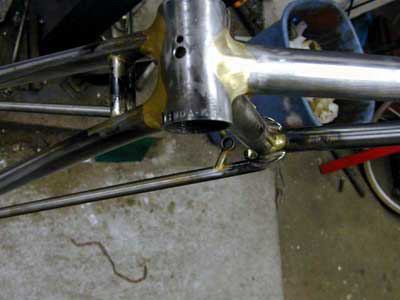

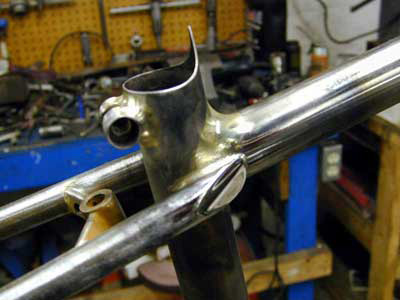
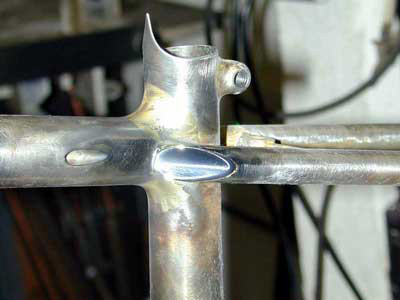
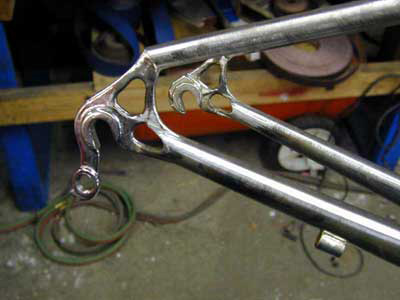
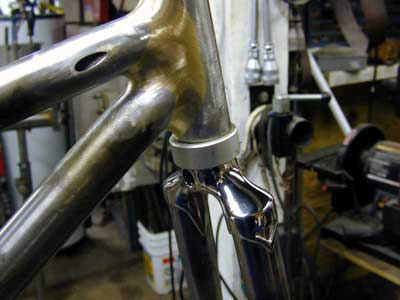

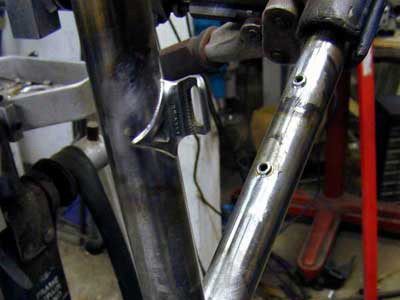


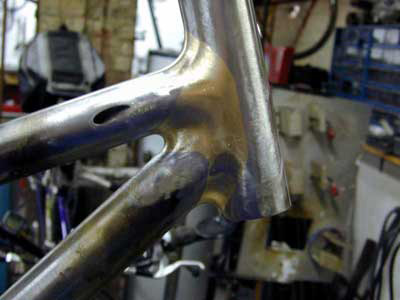
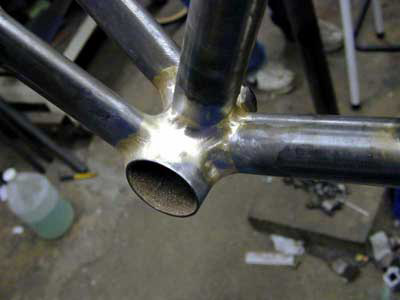
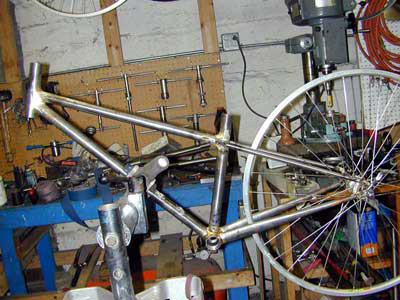
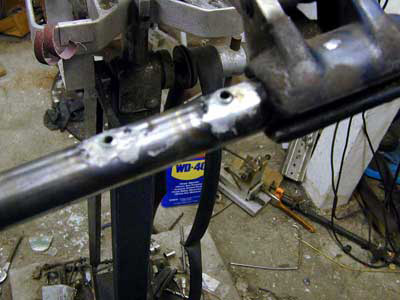

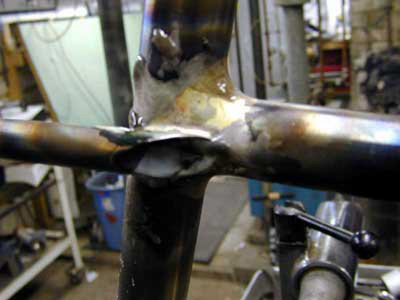
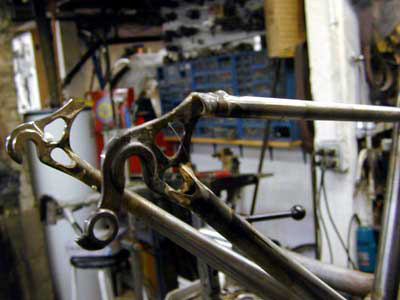


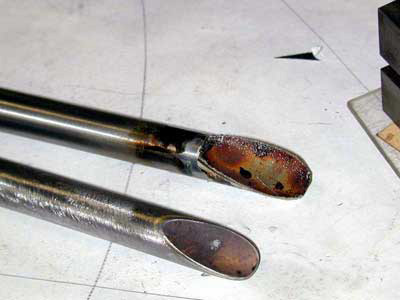
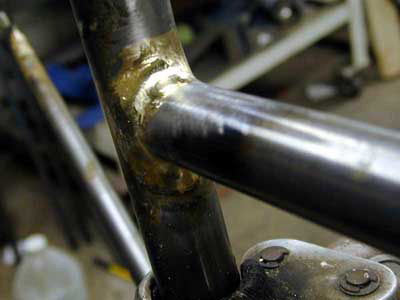


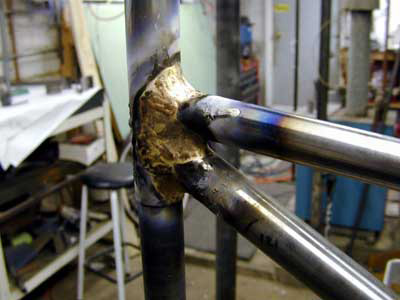

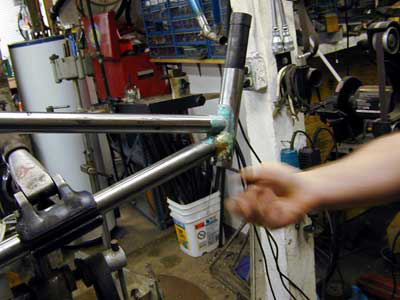


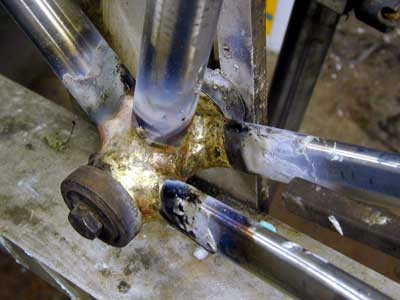
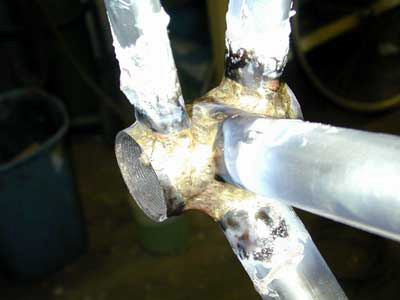

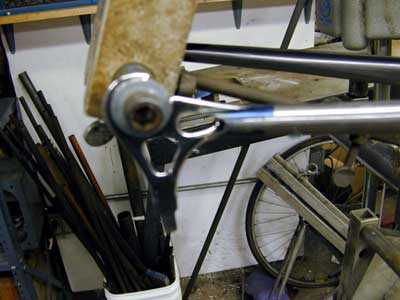


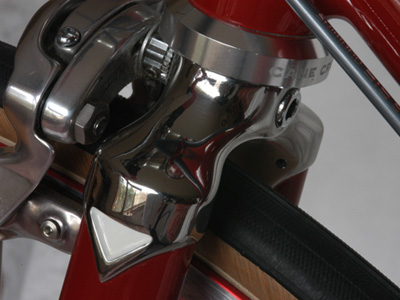
A lot of time was taken to polish the stainless steel fork crown and seat stay caps to get a mirror-finish:
Little Red Riding ‘Hood
Then, the frame and fork were sent off to be dipped in zinc-phosphate rust inhibitor to remove any internal and external rust, as well as to provide a sacrificial zinc coating to all the non-stainless, steel surfaces.
Finally, during late October of 2002, the frame and fork were carefully boxed and shipped off to California for finishing by Joe Bell. The anticipated wait time in the paint queue was six months! Perfection takes time.
The frame came back from California with flawless paint during the beginning of May 2003. The wheels were hand-built by Colorado Cyclist. I built up the bicycle as a gift to the owner during late May 2003.
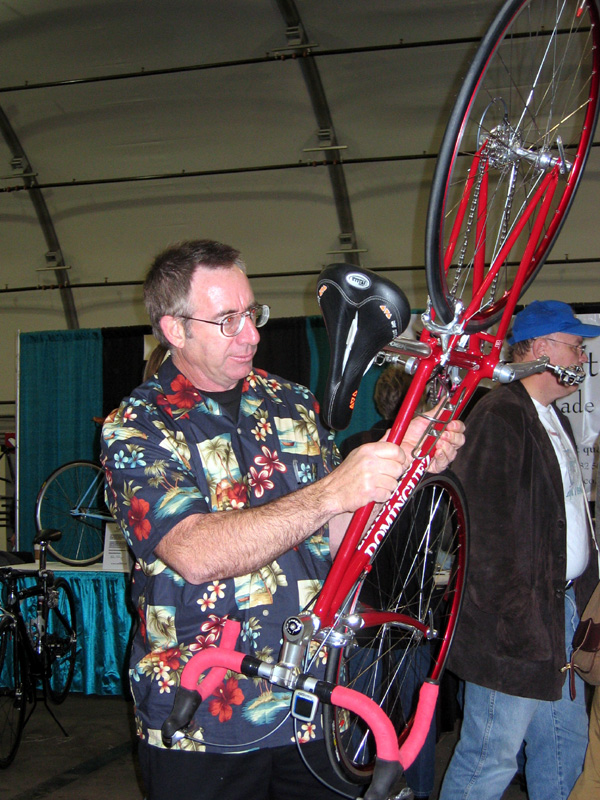
The frame was shown at the second annual (2006) North American Handmade Bicycle Show (NAHBS) in San Jose, California, where I met Joe Bell for the first time. He stopped by to see how his work was holding up after nearly three years:
This bicycle went with me to NAHBS in 2010 (Richmond, Virginia), now fitted with a color-matched stem and Vredestein Fortezza 700C x 25mm tires, which were more supple than the Volante model they replaced:

Year after year, this little bicycle was ridden regularly and meticulously maintained.
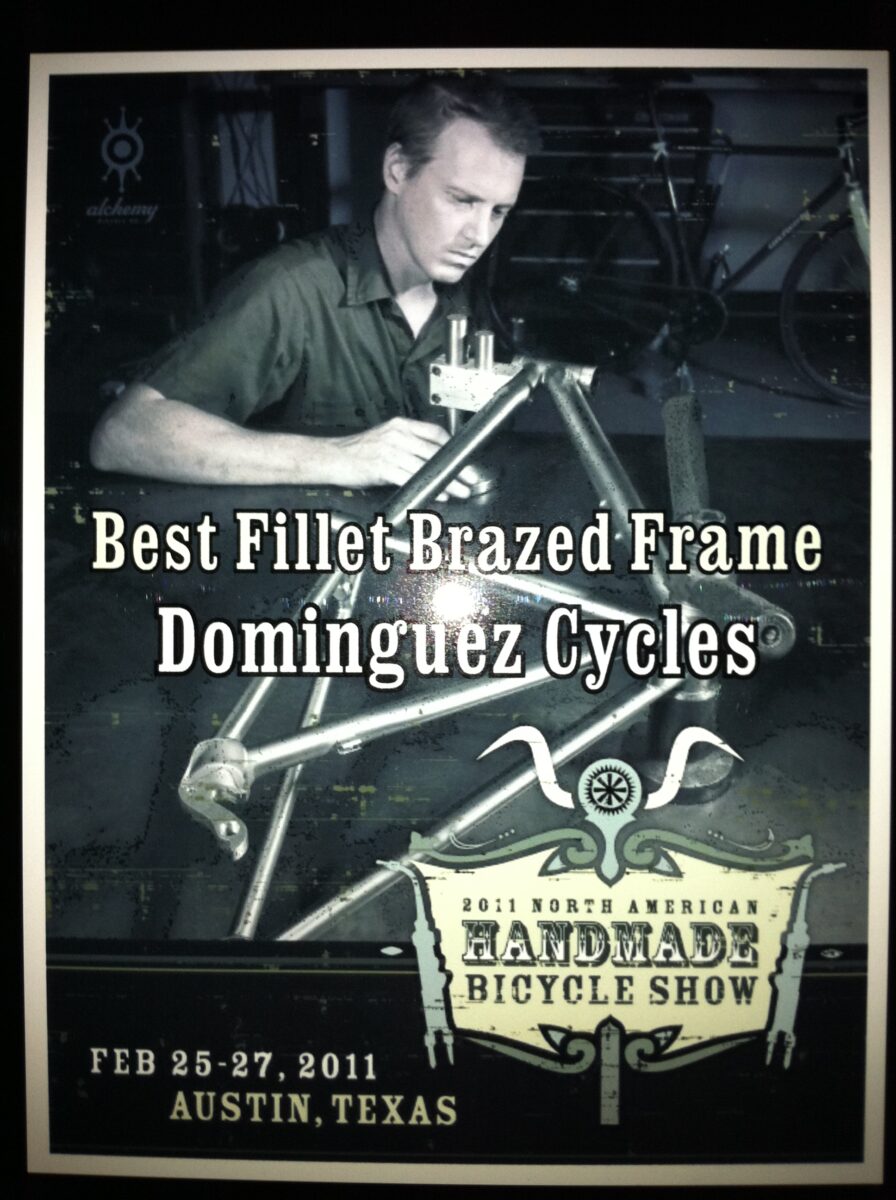
Nearly eight years after it was completed this bicycle was, surprisingly, selected for the “Best Fillet[-]Brazed Frame” award at the 2011 NAHBS:
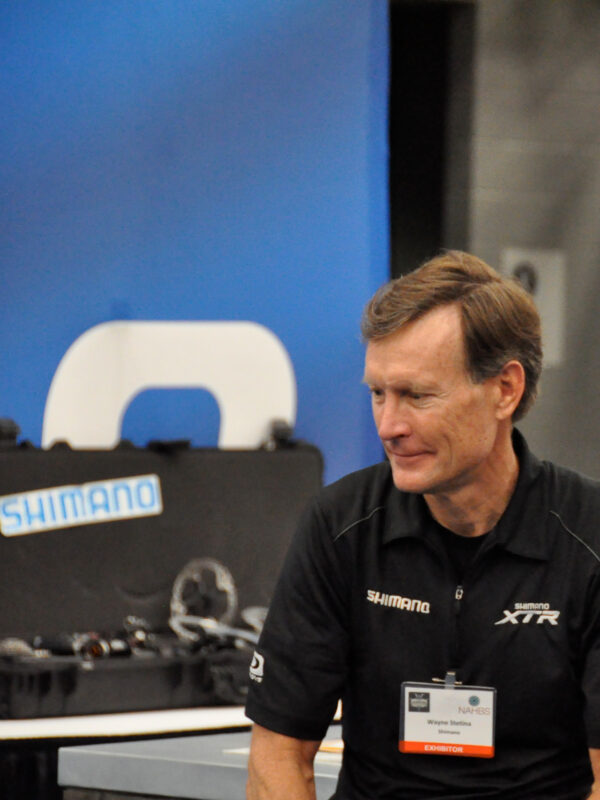
Following that show, I received a care package in the mail from Wayne Stetina, Shimano USA: a set of fresh Dura-Ace FC-7701 crank arms in 172.5mm length to replace the overly long 180mm crank arms originally fitted.
I appreciated the generous gift very much, and fitted the crank arms with some fresh, red-anodized Specialités T.A. Alizé chainrings for the new season of riding:
A generic award plaque arrived in May, three months after the show and exactly eight years after frame #1 was assembled. The plaque has sat in a box ever since, except the one time I took a photo of it to put on this web site. The recognition for the 230 hours of my labor that went into this frame was much appreciated. Thanks to Don Walker & Co. for organizing and hosting the show!
Frame #1 turned out well for my first effort.

Afterwards
“Bicycles are just as good company as most husbands. When a bicycle gets shabby or old, a woman could dispose of it and get a new one without shocking the entire community.” ― Ann Strong, Minneapolis Tribune (1895)
This bicycle was last seen looking good-as-new in the wilds of Saint Paul, Minnesota, during 2014. Some bicycles are worth keeping and never letting them fall to shabbiness. Hopefully, it continues to be properly maintained and thoroughly enjoyed to this day.
Wishing the owner all the best and many happy miles on it!
Postscript
Do you need or want a beautiful custom bicycle or replica? Do you have a treasured bicycle that needs repair, alteration, renovation, or restoration? Well, you can contact this old frame builder to do the work well and with great care.