


“It is a truth universally acknowledged that a creature in possession of good fortune must be in want of more Dura-Ace.” ― Jane Austen, Pride and Prejudice
My concept for the 1979 Koga-Miyata MXA frameset had started out quite nebulous. But, upon rummaging through my parts stash, it quickly coalesced into a workable plan…
Hoarding [Dura-Ace] is Not a Problem, It’s the Solution
Putting together just the right parts was a labor that spanned decades. It was labor that I undertook early in life, assuring myself a comfortable stash of just the right parts. To me, the “right” parts mostly meant Dura-Ace. And, it wasn’t so much “labor” as the in-grained habits of a discerning, prodigal pack rat presented with shiny things. Like a magnet attracting only iron, certain parts were drawn to me when they were within my influence.
Exchanging surplus currency for functional treasure is always an easy choice. The value of fiat currency is capricious, whereas bicycle parts have long-term intrinsic value and utility. A lot of Dura-Ace and other parts (just enough) found their way into my treasure stash. But, what good is treasure that isn’t put to use?
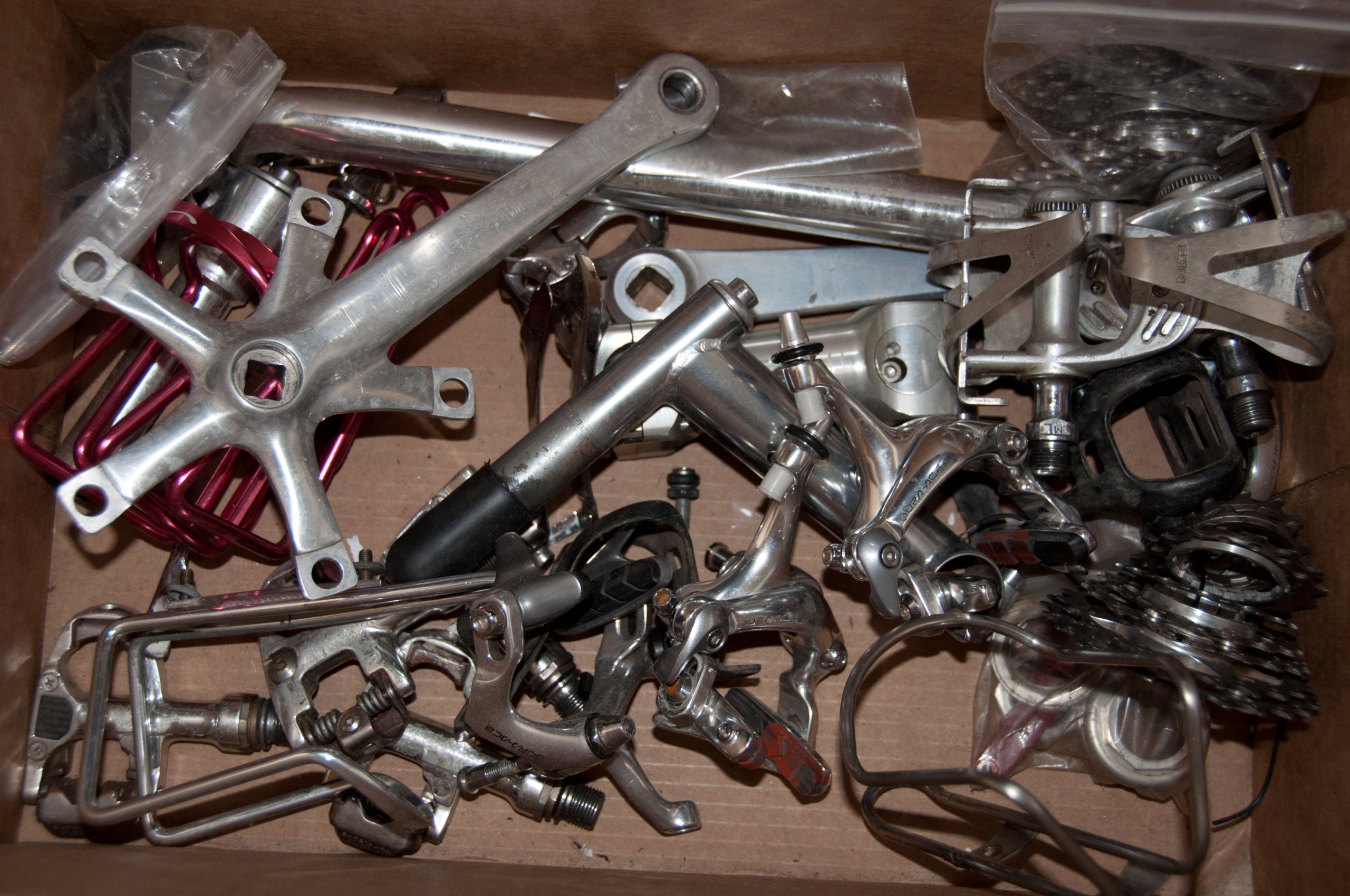
Some of my treasure would be used for this project:
| Part | Description |
|---|---|
| Headset | Shimano Dura-Ace (HP-7400) - Al alloy, silver, 1" (26.4mm CRS), loose-bearing |
| Stem | Nitto Pearl - Al alloy, 90mm (95mm), silver |
| Handlebars | Nitto Model 177 - Al alloy, silver, 44cm x 26.0mm |
| Handlebar wrap | Walnut - leather, black, black cotton stitching |
| Handlebar ends | Velo-Orange - plastic, black |
| Seatpost | Nitto Model S65 - Al alloy, silver, 26.8mm x 250mm, set-back |
| Saddle | Selle Italia SLK - leather/FeMnMo alloy, black, slotted |
| Brakes | Shimano Dura-Ace (BR-7402) - Al alloy, silver, short-reach |
| Brake shoes | Shimano Dura-Ace (BR-7900) - Al alloy, black |
| Brake pads | KoolStop Dura Pads - salmon, all-weather |
| Brake levers | Shimano Dura-Ace (BL-7400) - Al alloy, non-aero, silver |
| Brake cable | Shimano - stainless |
| Brake cable housing | Shimano SLR - Fe alloy/plastic, PTFE-lined, black |
| Shift levers* | Shimano Dura-Ace (SL-7400) - Al alloy, polished, SIS, 6-speed |
| Shift cables | Shimano - stainless |
| Shift cable housing | Shimano SIS - Fe alloy/plastic, PTFE-lined, black |
| Dérailleur – front | Shimano Dura-Ace EX (FD-7200) - Al/Fe, braze-on, silver |
| Dérailleur – rear | Shimano Dura-Ace EX (RD-7200) - Al alloy, short cage, silver |
| Bottom bracket | Shimano Dura-Ace EX (BB-7100) - Fe alloy, English, loose-bearing |
| Crankset | Shimano Dura-Ace EX (FC-7100) - Al alloy, silver, 170mm |
| Chainrings | Shimano Dura-Ace EX (FC-7110) - Al alloy, black, 42/52T, 3/32" |
| Cassette | Shimano Dura-Ace EX (CS-7200) - Fe alloy, gold, 13-14-15-16-17-18T, 6-cog |
| Chain | Shimano UniGlide (CN-6110) - Fe alloy, 3/32", black/gold |
| Pedals | MKS RX-1 - Al alloy, silver/black |
| Toe clips | MKS - Fe alloy, chrome, black leather covers, extra large |
| Toe straps | MKS Alpha Spirit - leather, black |
| Hub - front | Shimano Dura-Ace EX (HB-7200) - Al alloy, silver, 36-hole, 100mm |
| Hub - rear | Shimano Dura-Ace EX (FH-7200) - Al alloy, silver, 36-hole, 130mm |
| Rims | Mavic Open Pro - Al alloy, black, 700C x 19mm, clincher |
| Rim tape | Ritchey - plastic, 13mm, yellow |
| Tires | Panaracer AGXERO - rubber/nylon, black/tan, 700C x 28mm (26mm) |
| Inner tubes | Vredestein - butyl, 700C x 18-25mm, presta (40mm) |
| Spokes | DT Swiss Champion - 1.8mm (15ga.), silver, 3x lacing |
| Quick-release* | Shimano Dura-Ace (QR-7400/7402) - Fe alloy, chrome |
| Water bottle cages | Minoura - Al alloy, black |
| Pump | Zéfal HpX - Fe/Al alloy, color-matched |
| Alternative Drivetrain: | |
| Chainrings | Shimano Ultegra (FC-6400) - Al alloy, silver, 42/52T, 3/32" |
| Cassette | Shimano Dura-Ace (CS-7400) - Fe alloy, silver, 13-15-17-20-23-26T, 6-cog |
| Chain | SRAM (PC-870) - Fe alloy, 3/32", silver |
| Brake shoes | KoolStop DuraPads - Al alloy, silver |
| Pedals | Shimano Dura-Ace (PD-7810) - Al/Fe alloy, silver/grey, SPD-R |
| Weight | 9.9 kg (21.8 lbs.) |
| * Refurbished. | |
The plan was to equip this bicycle primarily with Dura-Ace EX, much like the 1979 Koga-Miyata Pro Racer, but with next-generation, indexed shift levers, brake levers, and brakes. This multi-generational Dura-Ace concept was similar to that of the Pro Racer models from 1984.

While still keeping the overall aesthetic of the 1979 Koga-Miyata Pro Luxe and both Pro Racer models, I intentionally chose to use five very specific 7400-series Dura-Ace parts (instead of Dura-Ace EX parts) for their unique functional attributes and aesthetic qualities.

Contemporary, classically styled components would supplement the non-Dura-Ace parts.

Brakes
Of all the bicycle parts from the 1970s and early 1980s, I don’t miss the side-pull brakes at all. From any manufacturer. Have you ever tried to stop from 88 kph (55 mph) flying down a mountain road with 1970s-era side-pull brakes? It’s not fun. Of course, this begs the question, who is the genius riding 88 kph down a mountain road with sub-par brakes? You don’t need to guess, it was Vincent the [much] Younger.
Cantilever and center-pull brakes of that era were functionally adequate, but it wasn’t until the mid-1980s, when SunTour came out with their beefy Superbe Pro and Shimano their “new” Dura-Ace BR-7400, that side-pull brakes did more than just slow down the rider: stopping became a viable option.
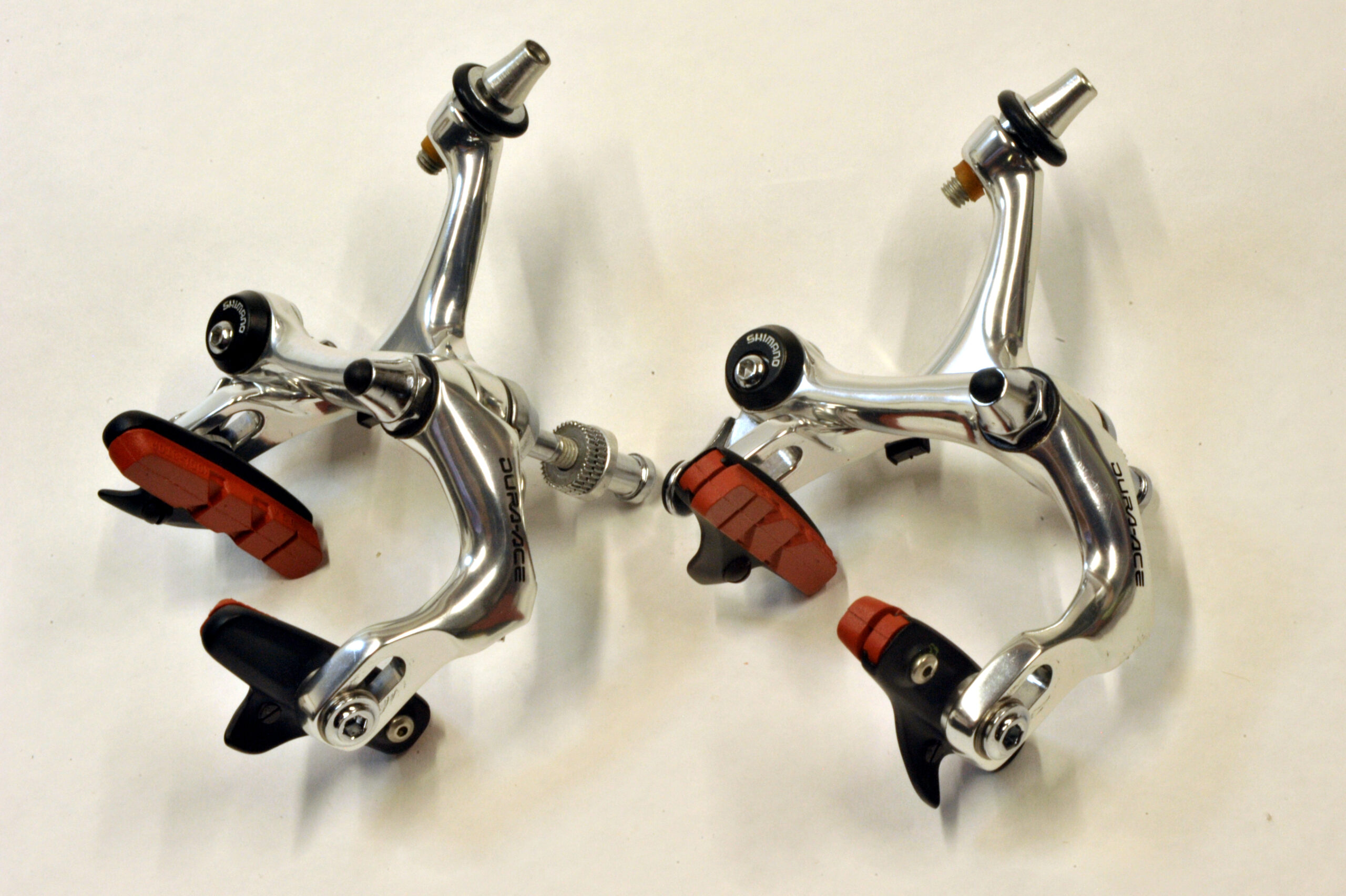
This bicycle was meant to be ridden with enthusiasm over hilly terrain, which meant that being able to stop safely and quickly was a priority. And that meant more “modern” brakes than Dura-Ace EX. At least, that’s what I told myself since I already had a pair of new, old-stock BR-7402 side-pull brake calipers. Not only do they stop well, they are beautiful. The brake calipers were new, old-stock sourced from Belgium.
The brake pads were still functional, but the grey brake shoes did not fit the overall aesthetic I sought. So, to increase their efficacy and visual appeal, Dura-Ace (BR-7900) black-anodized brake shoes and KoolStop salmon (wet-weather) brake pads replaced the original BR-7400 Dura-Ace brake shoes and pads.
Wheels
As important as the frame, the wheels give a bicycle its old-time nickname: “wheel”.
Every part was well-considered. The wheels had to be reliable, light (for climbing and accelerating), strong (to carry my pear-shaped [m]ass around), and low-maintenance.

The new, old-stock hubs are Dura-Ace EX (7200-series), sourced from England. These hubs feature a “Uni Balance Mechanism”: the flange spacing is more equidistant from the centerline, making for a stronger, more evenly tensioned rear wheel with less dish than that found on other hubs of the era. I emphasized that concept by re-spacing the rear frame triangle from 126mm to 130mm.
I replaced the rear hub axle with a high-quality Wheels Manufacturing 141mm axle, adding a 4mm spacer to the non-drive-side hub axle, thereby further reducing dish. This also gave me the added benefit of being able to use other road wheels with 130mm spacing, should I choose to do so. The wheels were built after the hubs had been re-spaced.
The Dura-Ace EX hubs also introduced separate “cassette” cogs and an integrated freewheel body with outboard bearings that supported the axle at the points of highest stress. This made for a much stronger rear wheel as well, less prone to axle breakage or bending. Vincent the Younger never experienced axles bending or breaking; Vincent the Elder wants to keep it that way.
Tires contribute a great deal to the ride characteristics of a bicycle. Although the ride of sew-up tires is delightful, this Koga-Miyata bicycle will be used only occasionally. The ease of changing and repairing flats outweighs the marginal gain in ride quality that good (expensive) sew-up tires provide.
I haven’t ridden tires narrower than 25mm since before the end of the last millennium, so the 21mm tire width originally equipping the Pro Luxe was also not under consideration. There is insufficient room under the brake bridge and fork crown for tires any larger than 28mm (actual size). For this build, I am trying for the first time some economical Panaracer AGXERO 28mm (actual width is 26mm) clincher racing tires.

The clincher rims I chose are also from Mavic, as on the Pro Luxe, but slightly more contemporary: black-anodized welded-seam OpenPro rims with machined sidewalls. I prefer DT Swiss spokes, so didn’t bother sourcing the Hoshi spokes found on the Pro Luxe; the wheels are hand-built (by Paul Wyganowski) for durability and longevity, using 15-gauge stainless steel DT Swiss Champion spokes and nickel-plated brass nipples.
The re-spacing of the 1979 Koga-Miyata MXA rear frame triangle and Dura-Ace EX rear axle meant that the original Dura-Ace EX rear skewer would be too short to use. Although I really like the Dura-Ace EX skewers, I wasn’t comfortable with how little thread was left to engage the nut. And, I still prefer the chromed Mount Fuji-profiled quick-release nuts with D-rings on the 7400-series parts: I had several for 130mm-spaced hubs in my spares drawer. These were overhauled and polished to make them like-new again.
Drivetrain
To me, the crankset is the visual focal point of any bicycle. For this bicycle, only a 7100-series crankset would do, as originally specified for the Pro Luxe and Pro Racer bicycles. However, rather than the silver chainrings found on the Pro Luxe, this Luxe would use the black-anodized chainrings found on the Pro Racer to better complement the chosen frame color and overall aesthetic.
This 7100-series Dura-Ace EX crankset is a classic beauty!
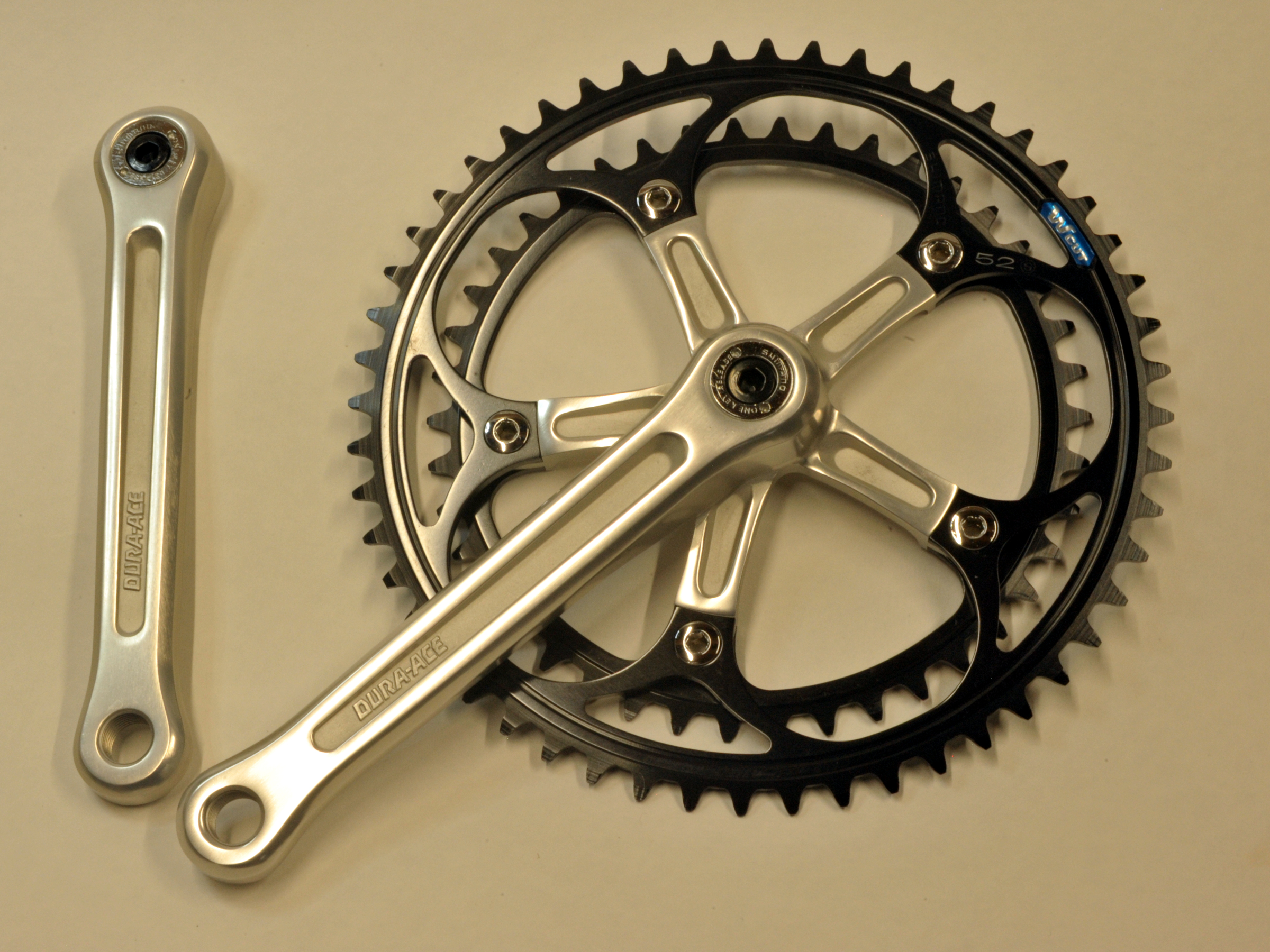
The crank length is the ubiquitous 170mm length, and chainrings are configured with the tooth-count standard for the time: 42 and 52 teeth. That should make climbing a “fun” challenge.
Of course, the crankset turns on a Dura-Ace EX 7100-series bottom bracket bearing assembly. This assembly has a fixed cup and an adjustable cup. Simple and reliable. The caged bearings were liberated and joined by one extra bearing on each side to share their burden. In theory and practice, this increases load-carrying capacity and enhances longevity. There are no seals, however, so regular overhauls are mandatory!

The crankset and bottom bracket bearing assembly are new, old-stock Dura-Ace EX 7100-series parts.
If you are a collector of this and that, like this me, you probably have a crankset of astounding aesthetics very similar to it in your bicycle parts stash. Don’t just look at it, people, put it on a bicycle and ride it! But take a photo first, so it will always look “new”.
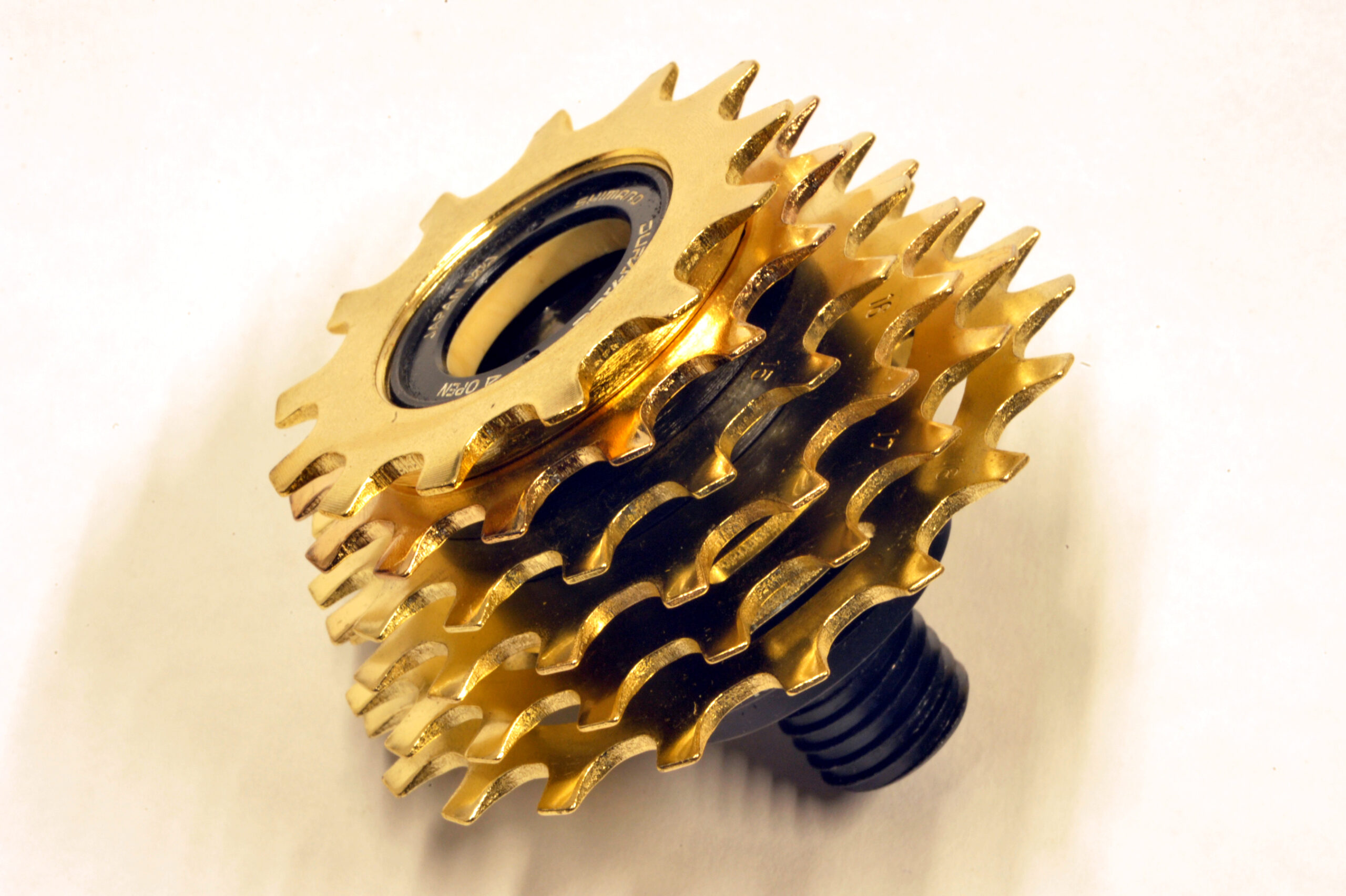
The cassette is the same six-cog, gold-color UniGlide Dura-Ace EX cassette as found on the Pro Luxe. This bicycle has slightly lower gearing and range than the Pro Luxe and Pro Racer (13-18T vs. 12-17T), making for slightly easier hill-climbing, but not exactly easy when compared to the gear ranges found on contemporary bicycles.
New, old-stock Dura-Ace EX dérailleurs found their way into my treasure trove over the years, sourced from the same Belgian supplier as the brakes. These are the last iteration of Dura-Ace EX, the same as on the 1984 Pro Racer-S (1983 vintage, 7200-series parts). Surprisingly, they are compatible with the newer 7400-series shift levers and indexed shifting.

To add a touch of black to the otherwise very shiny silver rear dérailleur, the area around the “Dura-Ace” lettering on the outer parallelogram was painted black, then filled with clear resin. It’s what stylish, enthusiastic velophiles do. Probably.
For reasons of economy and aesthetics, a Shimano UniGlide 600 (CN-6110) chain is used instead of a new, old-stock Dura-Ace chain (because I couldn’t find one at a reasonable price). The chain was chosen for its gold color outer links (to complement the gold-color CS-7200 corncob cassette) and 6-speed compatibility.
User Interface
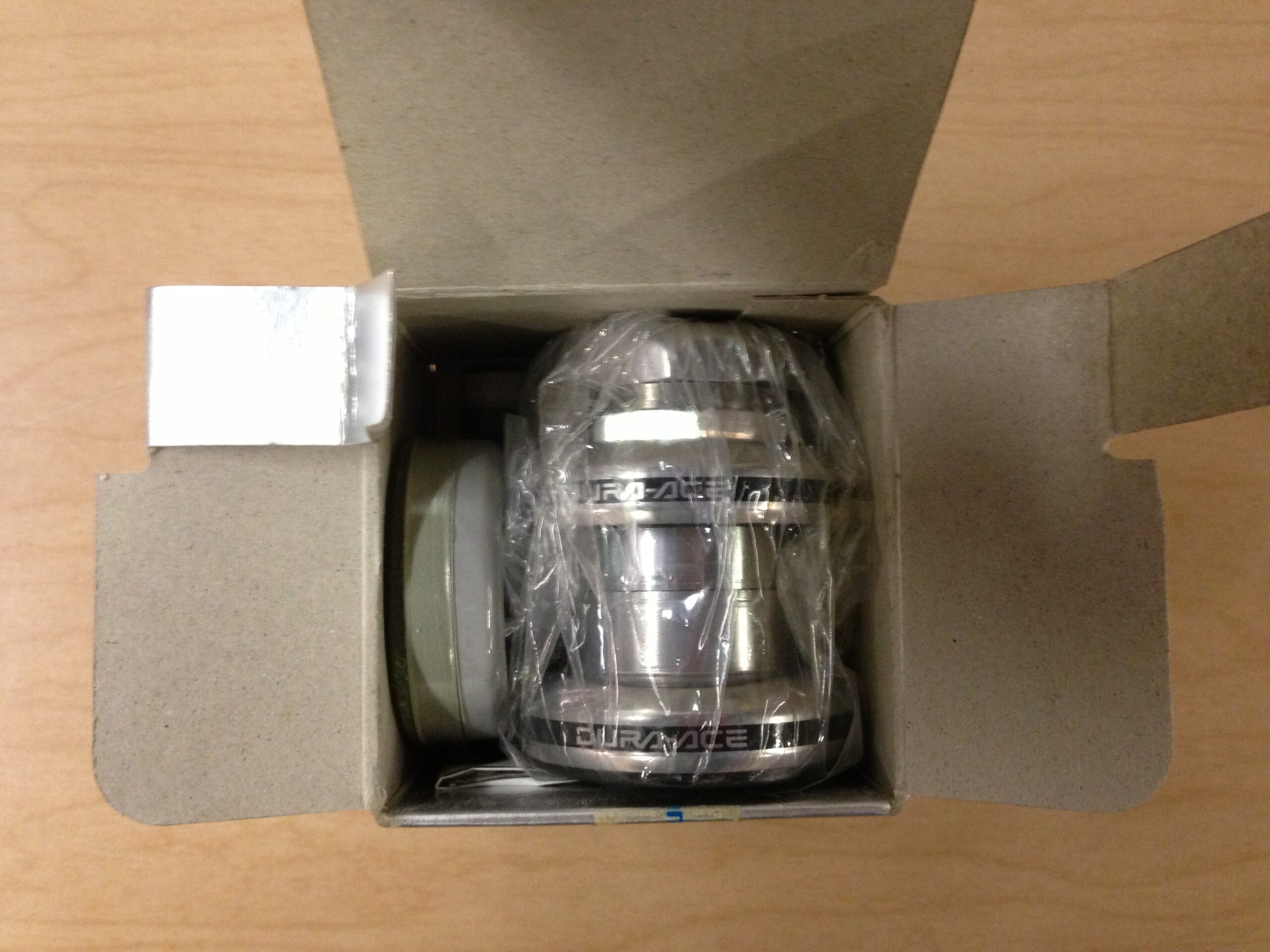
Unfortunately, I did not have occasion to use my Shimano EX “Special Tools for Head Parts”: I did not have any new, old-stock Dura-Ace EX headsets in my parts stash. And, for some reason, these are very expensive to acquire (rarity? Really? After only 45 years?!?). The economical choice was to use a spare 7400-series headset that I did have. This model headset has caged-bearings. I “liberated” the bearings (and added one extra to each set of 20) for increased load-carrying capacity and enhanced longevity. The silk-screened graphics were removed to make the headset appear more “retro” – not readily identified as a “new” Dura-Ace part, except by the locknut and date stamp (“PE”).

The shifting of the Dura-Ace EX dérailleurs is excellent using friction shift levers. However, I have become spoiled and lazy using indexed shifting since 1987, so the choice to use indexed shift levers was another intentional departure from the original specifications of the Pro Luxe. The down tube shift levers are refurbished “new” Dura-Ace braze-on (Campagnolo-style mount) 7400-series shift levers (manufactured 1985) from my parts bin. One of the two internal engaging splines is broken, but it still appears to work just fine…
These shift levers are from my very first complete Dura-Ace group (1987), not used since 2013 (I wonder why?). A simple overhaul and polish made them nearly good-as-new. The shift levers are six-speed, with selectable indexed and friction modes and compatible with the older EX dérailleurs.

The contemporary Nitto Model 177 handlebars are similar to the original SR Royal handlebars, but finished with contemporary black-anodized Nitto aluminum bar ends. Like the Pro Luxe, and for a touch of luxury, the handlebars are wrapped in black leather (Walnut Studiolo) with black cotton stitching to complement the not-period-correct, but comfortable, Selle Italia SLK saddle. The “Selle Italia” and “SLK” graphics were removed to better fit in with the other debadged parts (headset, rims, seatpost). Unlike the original Pro Luxe and Pro Racer, this bicycle is outfitted with a contemporary Nitto S65 Crystal Fellow (250mm) seatpost.

To convey the late-1970s, early-1980s look, quill pedals with toe clips and straps are fitted. The pedals, toes clips, and straps are all made by MKS, as on the original Pro Luxe. However, the pedals are modern RX-1 track pedals with black cages.
Alternative Drivetrain
The black-anodized Dura-Ace chainrings are too precious to use on unpaved roads and trails, as found on LARPing rides such as Eroica. This also applies to the gold-colored 600 EX UniGlide chain and Dura-Ace UniGlide corncob cassette. Those types of rides are also very challenging when it comes to hills, so the corncob cassette (13-18T) is supplemented with another cassette having a wider gear range.
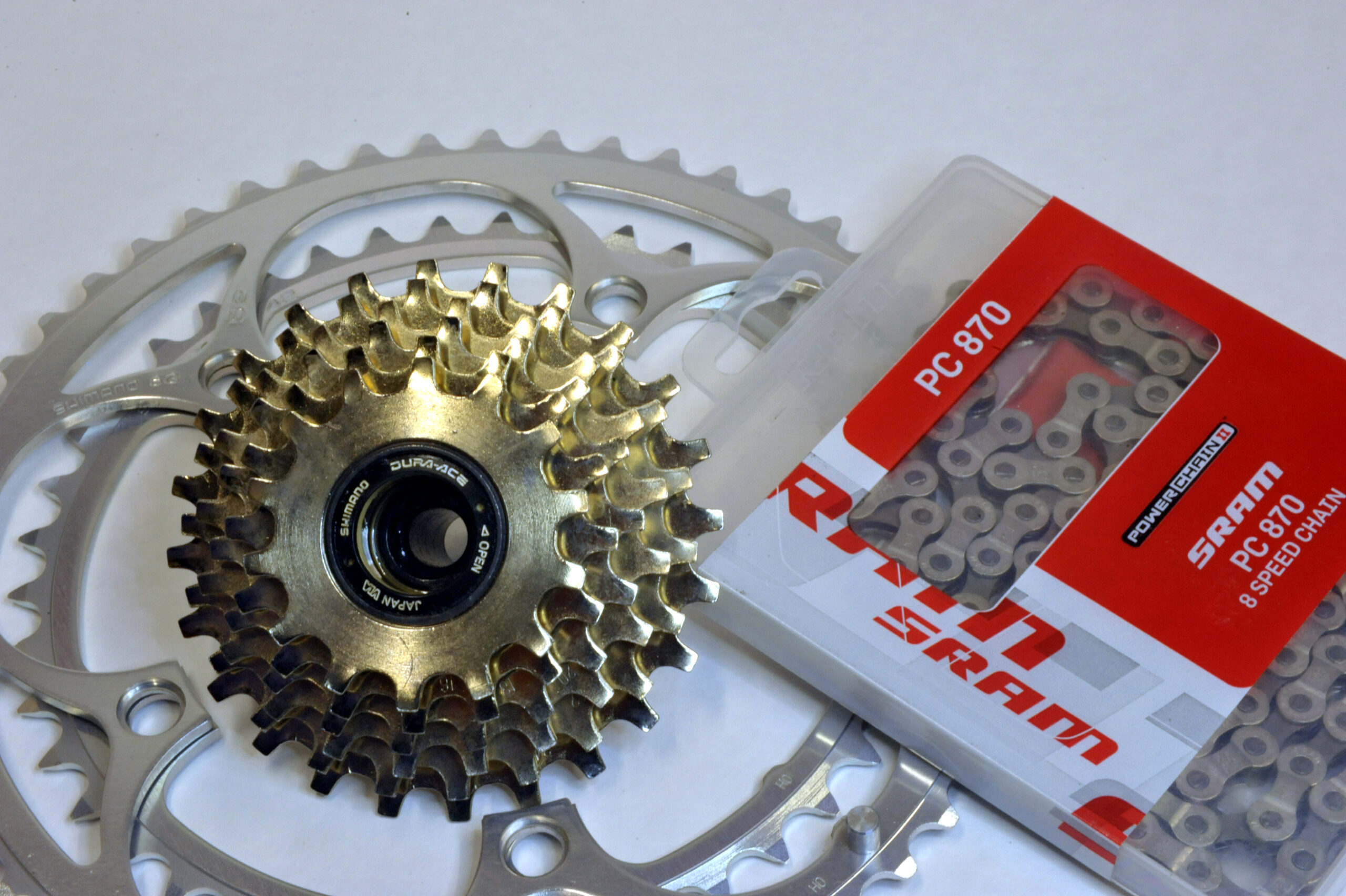
For long-distance, everyday riding, and any ride that subjects this bicycle to harsh environmental conditions, I have a spare, wider-range Dura-Ace UniGlide six-cog cassette (14-24T), which is perfectly adequate for most of the hills where I ride. As a last resort, I have spare silver cogs to build up a 13-26T cassette. For such conditions, I also fit silver Ultegra (6400-series, 42/52T) chainrings and a silver SRAM PC-870 chain.
A set of contemporary Dura-Ace clipless pedals was also allocated, to be substituted during Nova Eroica rides or for when I wanted the security and peace of mind while climbing hills with wild abandon.
Accoutrements
Cables and housing are modern Shimano SLR- and SIS-specific for best braking and shifting performance. All the control cables are stainless steel.
Postscript
Do you need or want a beautiful custom bicycle or replica? Do you have a treasured bicycle that needs repair, alteration, renovation, or restoration? Well, you can contact this introspective frame builder to do the work well and with great care.