


“Doing what you love is the cornerstone of having abundance in your life.” — Wayne Dyer, Staying on the Path
Wherein I do what I love, to help me do more of what I love to do. With recycling.
Magic Words: お願いします
Two-year-old simians and the like are willful, selfish, impolite creatures. If they know any magic words, they only use them selfishly. At that age, I knew several magic words, several of them in four languages (one of them made up). And when to use them.
From the first time I saw a model kit of a Mitsubishi A6M5 Zero (the 1968 re-release of the 1962 Monogram kit) in the local Kresge discount store (now Kmart), I knew it would be mine some day. Although I had to wait more than half a lifetime (at that point) before I could have it, I knew my usual tantrums would not sway the Elders. What was a poor, deprived, spoiled child to do?
“These little grey cells. It is up to them.” — Agatha Christie, Hercule Poirot: The Mysterious Affair at Styles
The Elders were immune to my tantrums, but not to my earnest, heart-felt plea, “Bitte? Für meinen nächsten Geburtstag?“. What doting grandparents could refuse my polite request? None, of course.
Opa supplied the single-edge razor and the $1.24 in cash ($11.38 today) for the kit and a tube of “glue”; Oma provided the construction guidance and supervision. Safety first, kids!
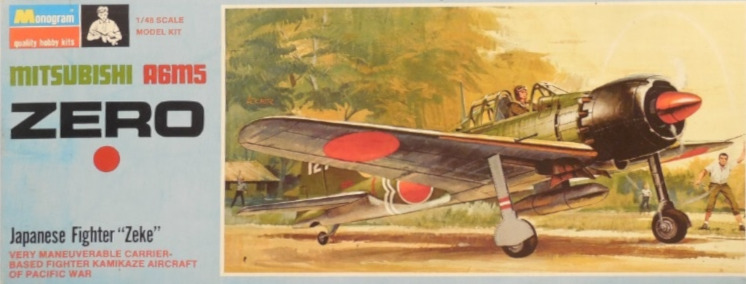
This was my first plastic model kit. My Oma dispensed the highly volatile, toluene-based, gelled solvent (“glue”) from the tube (because it was “schädlich“), but she let me wield the single-edge “safety” razor to cut and trim the parts. Her reasoning was cryptic, but unassailable, “Das ist doch selbstverständlich!“: of course, every child has to learn how to use a knife safely and correctly!…I was going to be a surgeon after all! Or a chef. Or a bank director. After showing me how to fit the parts together while avoiding touching the glue, the rest of the assembly was left to me.
I had graduated from 10-cent balsawood, rubberband-powered airplanes to something that looked “real”. Yet, the final result didn’t quite meet my expectations. Consequently, I did as any sensible child would do, I began a program of iterative, continuous [self-]improvement, seeking to improve the quality of the finished product with each kit built. Thus, destruction testing was also required, in the interest of continuous improvement, of course.
Leaning more towards chef than banker or surgeon, I soon learned to wield fire magic after that and many a finished plastic model kit met its fiery end under [always] controlled and [sometimes un-]supervised conditions. This was the first model kit to meet a fiery end at my hands, but not the last. Even then, it struck me as sad and wasteful to throw away plastic. What else could I do?
What to do with the remains of this sub-standard output from my first hobby? Refuse, of course! However, the five Rs of “refuse, reduce, reuse, repurpose, recycle” were not considered in the same way during the 1960s as they are today. In this situation, at the time, “refuse” meant trash. Plastic was cheap, and throwing it out was the norm – let it sleep with the fishes!
Over the decades, many things changed, but most stayed the same.
Super-Models

“Even socialist dictators have an interest in gorgeous super-models.” — Hugo Chavez (on the release of Tamiya’s kit #60309 – 1/32 scale A6M5 Zero, ca. 2000)
As a long-time, now intermittent, scale modeler, many model kits have found their ways onto my “build someday” shelf. My choice of kits has been refined. Now, every one of these – curated for production quality, fidelity, and fit – a super-model-to-be. And, my fire magic has been redirected more constructively.
The thought of making them without my full attention, burning them, or throwing them away is no longer considered. My treasure stash of “greeblies” is testimony to that. You never know what you’ll need for the next kit-bash or sci-fi model build!
To build one of these kits is no longer the work of an hour. Now, months- to years-long projects, I have accumulated several life-time’s worth, and most of the handtools to build them.
These curated kits are meant to be built, of course, but I find myself enjoying making fine hand tools and fixtures to support my creative endeavors just as much.

Some of the high-fidelity kits in my model kit treasure stash are manufactured by Zoukei-Mura. Their focus is primarily 1/32 scale aircraft from the second world war (that’s two too many, people!), replicating the internal structure and mechanics, even though much is never seen. Sadly, they have yet to release their own rendition of a 1/32 scale Zero. But, there’s still time…
I was inspired by the humble and enthusiastic writings of Hideyuki Shigeta, president of Zoukei-Mura, and his thoughts on “The Seven Tools” for modeling. The last tool, the work base, was a tool not in my collection of useful and functional objects. And, it was something I could make myself, with the “right” materials.
Refuse, Reuse, or Recycle?
Having become a prodigal pack rat with a plethora of hobbies and interests, it was inevitable that modeling would lead to jewelry-making and woodworking (just the same as it led to frame-building), as well as the accumulation of abundant raw materials that others have called “junk”.
About eighteen years ago, I was gifted the remains of a piece of Douglas fir. It was a gift I would never refuse: Douglas fir has a beautiful, straight grain and rich reddish-orange-tan color. It is strong, relatively dense, and easy to work. How could I refuse it?
This particular piece of Douglas fir was felled in 1956 or 1957 for incorporation into a ranch- or rambler-style house in the hinterlands near Saint Paul. It was used as the ridge beam in the garage until the garage was remodeled with a raised roof and new framing. The piece I was gifted measured approximately 9.5cm x 35cm x 3.65m (3.75″ x 13.75″ x 12′). It was warped and checked in various places from having been installed green, as was common for timbers at the time. What to do with it?
A bench vise needs a workbench, and a workbench needs a top. To make a solid, sturdy, smooth top, that single piece of Douglas fir became many odd lengths and widths of Douglas fir. To eliminate the checks, each piece was run through the jointer and the planer for a glass-like finish, all to a shared final thickness. Enough of these were glued together to make a top 90cm wide, 50cm deep, and 7.5cm thick. Cut-offs and the remaining unused pieces went into the stack of lumber, awaiting future projects.
About the same time, a dove-tailed box made from cherry wood found its way to me, but all the joints failed over the years and one of the sides had split. It wasn’t worth my time to fix, but the wood was too good to discard. Could I reuse it?
Inspiration
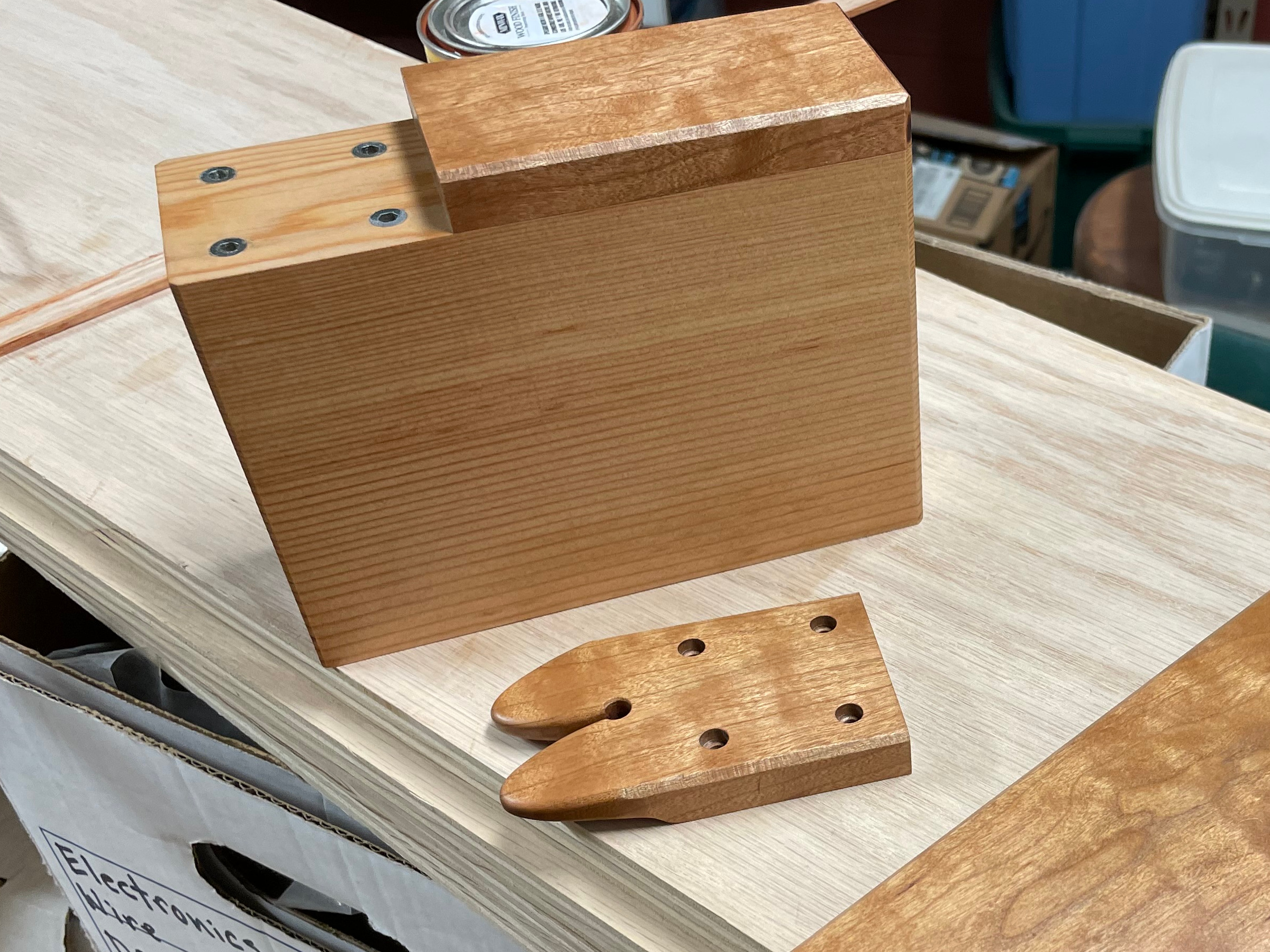
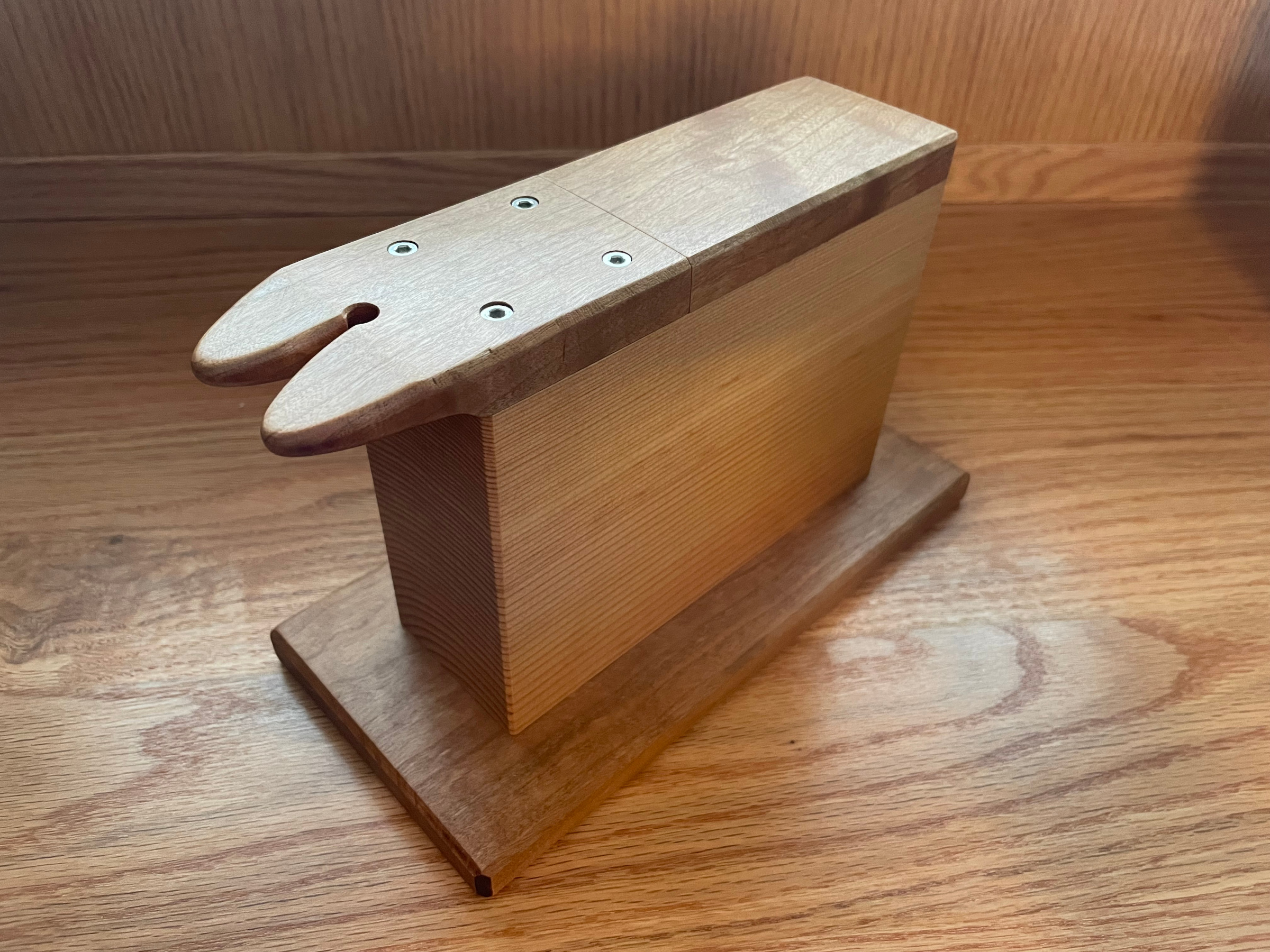
Around 2013, just before I read the blog entry mentioning the work base, I had been contemplating making a jewelers wooden bench pin for my modeling projects. Having read it, a spark was lit to make the hobby work stand instead. A left-over Douglas fir cut-off and one of the sides of that cherry box were the perfect raw materials. I finally made my own copy of the work stand eight years after that:
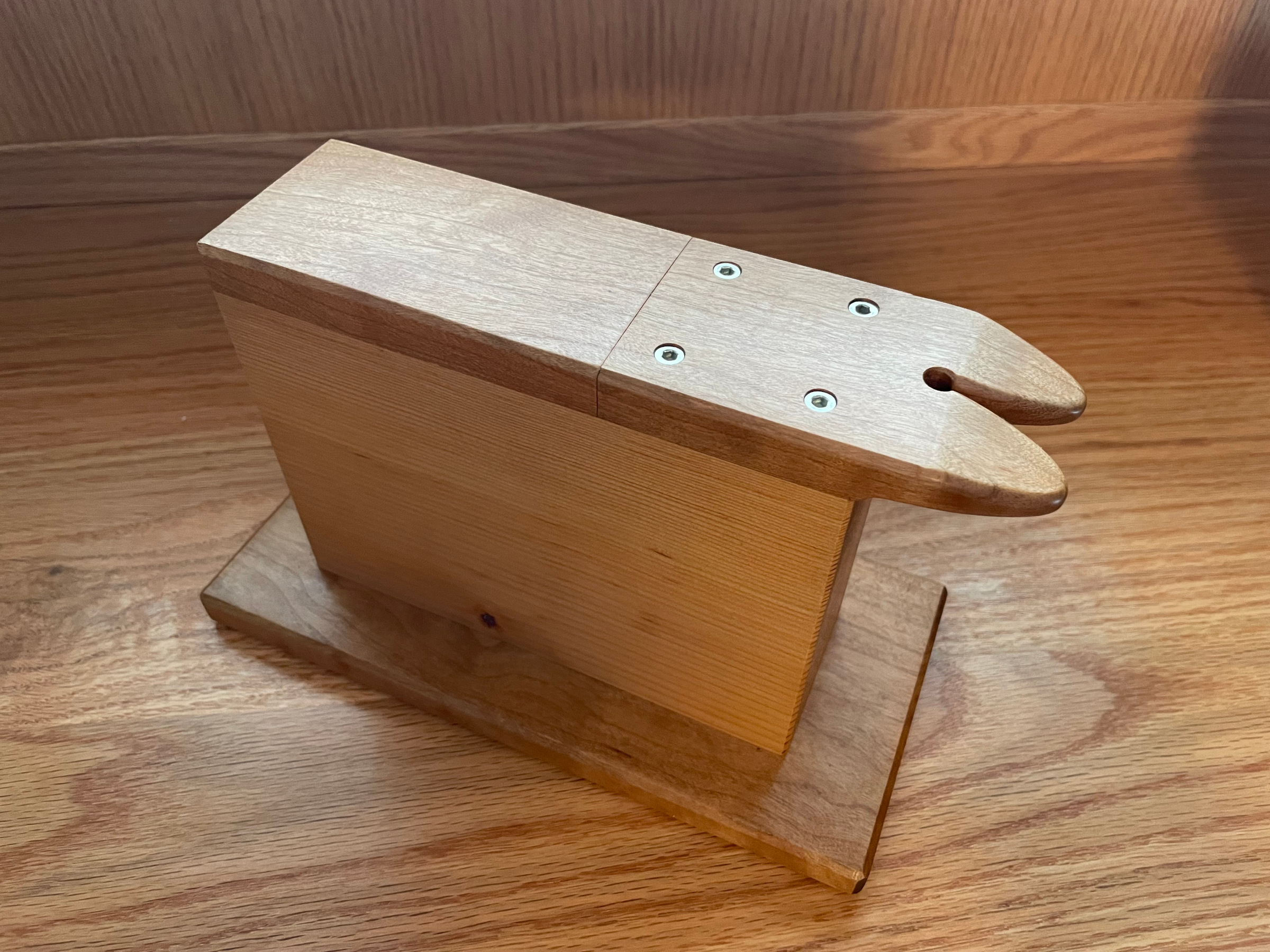
I’d like to say it works well, but I haven’t used it yet.
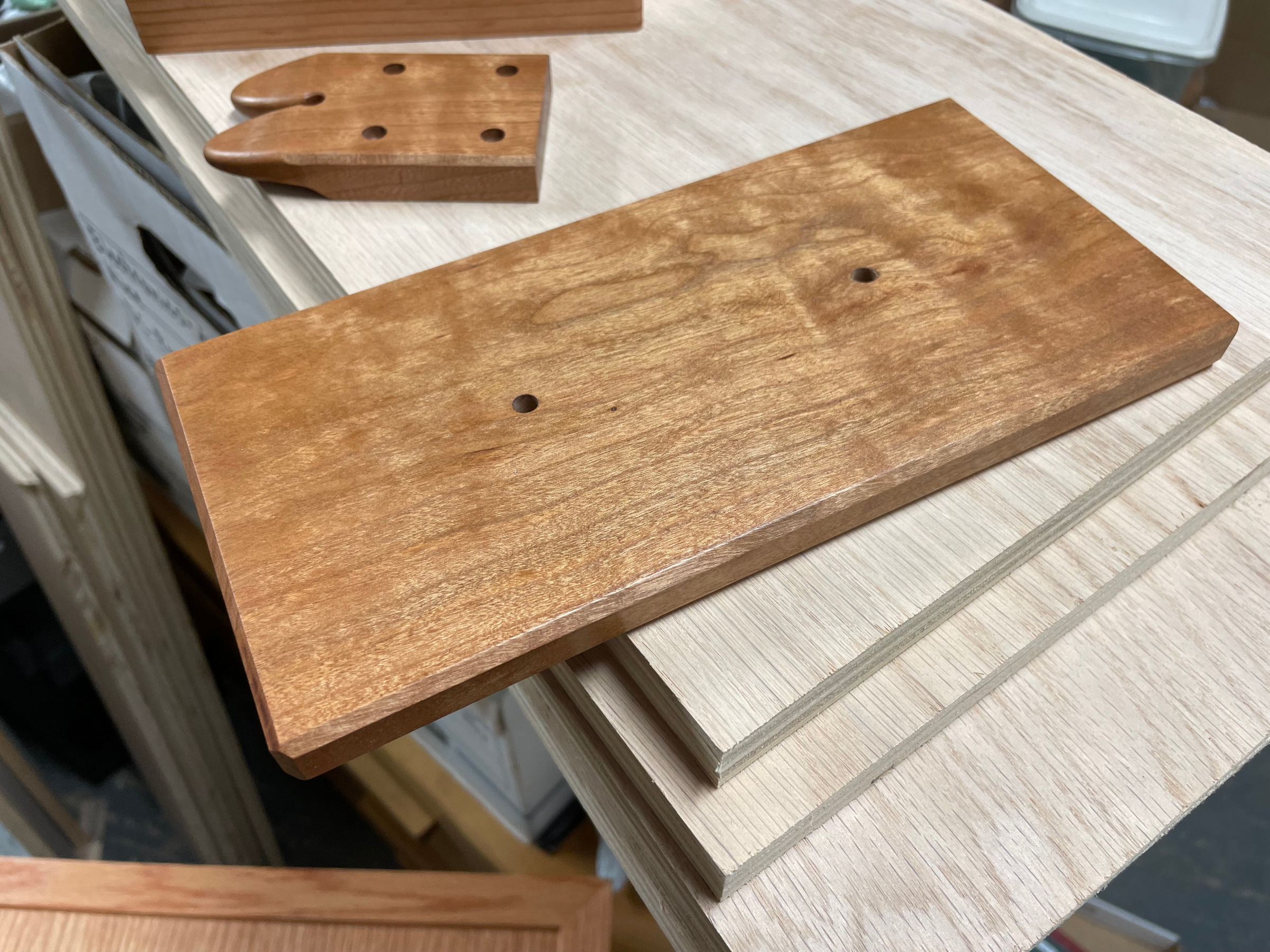
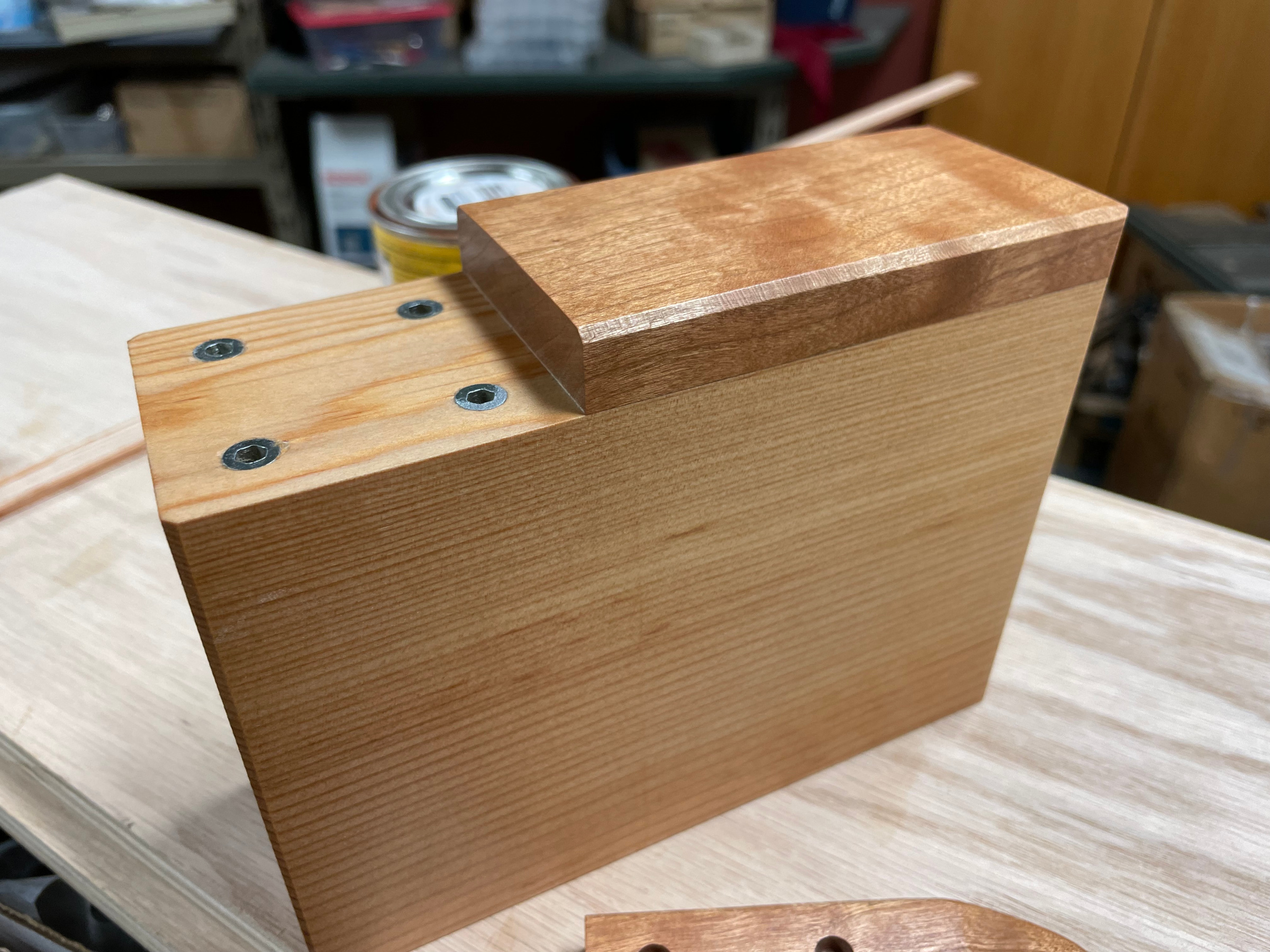
What other useful things can be made if we apply “refuse, reduce, reuse, repurpose, recycle, renovate, restore, repair, revitalize, refurbish” to every-day “trash”?
Postscript
Do you have “trash” you would like turned into something beautiful and useful? Do you want a hobby work stand for yourself? In either case, you can contact this re-cyclist with your inquiry.